When the Safety Net Becomes a Snare: The True Mechanics of Business Credit Line Debt
The Reassuring Story Lenders Tell at Signing
When a business owner secures a revolving line of credit, the conversation at the bank tends to be encouraging. The language is all about flexibility, access, and security. A line of credit is framed as a buffer against the unexpected—a financial cushion that sits quietly in reserve until it is needed.
That framing is not entirely wrong. Used correctly and sparingly, a credit line can bridge a temporary cash gap, smooth over a slow quarter, or cover a payroll cycle while receivables catch up. The problem is not the instrument itself. The problem is the gap between how most business owners understand it and how it actually functions under sustained use.
What begins as a safety net has a well-documented tendency to transform into something far more constrictive—particularly for growing businesses that encounter the line repeatedly and rely on it with increasing frequency.
How Interest Compounds Against You
Most business lines of credit carry variable interest rates tied to benchmarks such as the prime rate or the Secured Overnight Financing Rate (SOFR). When rates are low, the cost of carrying a balance feels negligible. When rates rise—as they did sharply between 2022 and 2024—the cost of the same balance can nearly double without any change in how the business is using the facility.
The compounding dynamic is more insidious than a simple rate increase. Unlike a term loan with a fixed amortization schedule, a revolving line allows businesses to make minimum payments, which are often structured as interest-only or as a small percentage of the outstanding principal. This structure creates a trap that is easy to enter and surprisingly difficult to exit.
Consider a business carrying a $150,000 balance on a line of credit at a rate of 9.5 percent annually. The monthly interest charge alone approaches $1,200. If the business makes only minimum payments while continuing to draw on the line for operational needs, the principal balance does not decline—it grows. The business is, in effect, borrowing money to pay for the privilege of having borrowed money.
Over twelve months, that same business may pay nearly $14,000 in interest while its underlying debt remains unchanged. Over three years, the cumulative interest expense can exceed the value of whatever the line was originally used to cover.
The Minimum Payment Illusion
Minimum payments are psychologically dangerous for business owners who are managing multiple financial priorities simultaneously. When cash is tight, the minimum payment appears to resolve the immediate problem. The account remains current. The relationship with the lender stays intact. The line technically remains available.
But minimum payments are not a neutral act. They are a decision to extend the duration of debt and increase its total cost. Every month a business makes only a minimum payment, it is choosing to pay more for the same capital over a longer period.
This dynamic is particularly damaging for businesses that treat their line of credit as a quasi-operational account rather than an emergency facility. When a credit line is used to cover inventory, payroll, marketing, and routine expenses on a revolving basis, minimum payments become structurally insufficient. The balance climbs steadily, available credit shrinks, and the business finds itself increasingly dependent on a resource that is simultaneously becoming more expensive and less accessible.
The Lender's Behavior During a Downturn
Perhaps the most consequential—and least discussed—aspect of revolving credit lines is how lenders respond when economic conditions deteriorate. The standard assumption among business owners is that a credit line will be there when it is most needed. The reality is precisely the opposite.
Lenders routinely review revolving credit facilities during periods of economic stress or when a borrower's financial profile weakens. Through a mechanism known as an adverse action or credit line reduction, a lender can unilaterally reduce the available credit limit, sometimes with as little as thirty days' notice. In severe cases, lenders may freeze the facility entirely or demand repayment of the outstanding balance.
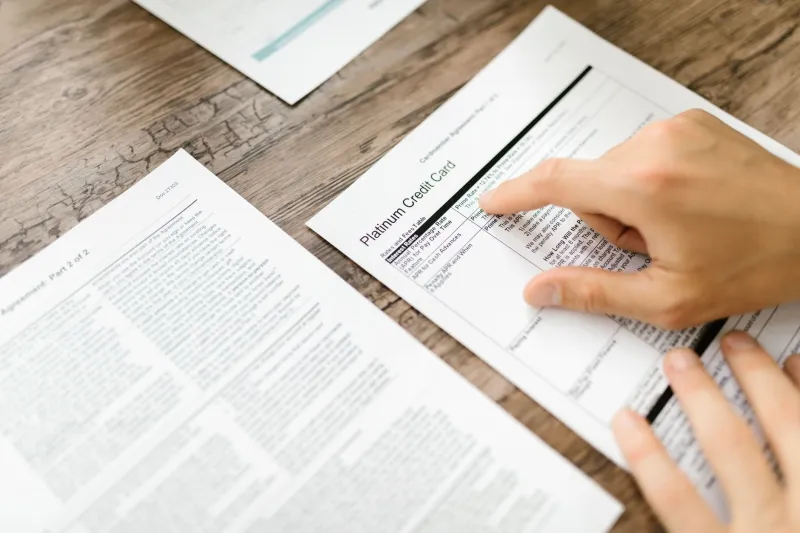
This behavior is not arbitrary. It is contractually permitted by the terms most business owners accept at signing without fully reading. The provisions that allow lenders to reduce or terminate access are typically buried in the loan agreement under language describing material adverse changes, covenant violations, or the lender's right to reassess creditworthiness at any time.
The timing creates a particularly painful paradox. A business that is struggling—experiencing a revenue decline, a slow receivables cycle, or a difficult quarter—is precisely the business most likely to need its credit line. It is also precisely the business most likely to have that line reduced or frozen by a lender responding to the same conditions.
Reading the Fine Print Before It Reads You
The antidote to these risks is not avoiding credit lines altogether. It is understanding the specific terms governing the facility before those terms are invoked against you.
Several provisions deserve particular attention during the review process:
Variable rate clauses should be examined for the specific index and margin used to calculate the rate, as well as any caps on how quickly the rate can change in a given period. An uncapped variable rate exposes the business to unlimited cost increases over the life of the facility.
Demand provisions allow certain lenders to call the entire outstanding balance due immediately under specified circumstances. This is more common in smaller community bank agreements than in larger institutional facilities, but it is not rare. A business carrying a large balance on a demand note faces potential insolvency if the lender exercises that right at an inconvenient moment.
Financial covenants often require the business to maintain minimum revenue thresholds, specific debt-to-equity ratios, or minimum cash balances. Violating a covenant—even inadvertently—can trigger a default, which may allow the lender to accelerate repayment or terminate the facility.
Draw limitations and fees vary considerably across lenders. Some facilities charge unused line fees, draw fees, or annual maintenance costs that increase the effective cost of the credit even when the balance is zero.
A More Disciplined Approach to Credit Access
Business owners who treat their credit line as a disciplined financial tool rather than a default funding source tend to fare considerably better. A few structural practices make a meaningful difference.
Establishing an internal policy that limits credit line draws to specific, short-duration purposes—bridging a confirmed receivable, covering a defined seasonal gap—prevents the drift toward chronic reliance. Tracking the average daily balance monthly, rather than only the end-of-period balance, gives a more accurate picture of actual utilization and cost.
Maintaining a payoff schedule alongside the minimum payment amount keeps the true cost of the debt visible. Knowing that a $100,000 balance at 9 percent will cost approximately $27,000 in interest over three years if only minimum payments are made is the kind of information that changes behavior.
Finally, reviewing the credit agreement annually with a financial advisor—particularly in a rising rate environment—ensures that the terms you agreed to at signing still represent acceptable risk at the current cost of capital.
A line of credit does not become dangerous by accident. It becomes dangerous through a series of small, reasonable-seeming decisions that accumulate into a structural problem. Understanding the mechanics before that accumulation begins is the only reliable form of protection.